

Collagen cream is beneficial as a moisturizer that keeps the skin's surface smooth, but it doesn't deliver collagen to the deeper layers of the skin. This is because a complete collagen molecule is much larger than the size needed to cross the skin barrier. The cream works on the surface, while supporting your body's natural collagen production requires other methods: nutrition, ingested hydrolyzed collagen, and carefully selected topical ingredients like retinol and sunscreen. In this article, we'll explain exactly what the cream does, what it can't do, and the difference between it and ingested collagen or a face mask.
Why doesn't the collagen in the cream penetrate deep into the skin?
The outermost layer of the epidermis (the stratum corneum) is designed to be a barrier that protects your body. There is a well-known rule in dermatology called the "500 Dalton rule," which states that a substance must have a molecular weight of approximately less than 500 Daltons in order to be absorbed through the skin, and larger molecules do not cross this layer easily ( Bos & Meinardi, Experimental Dermatology 2000 ).
Natural collagen has a molecular weight of approximately 300,000 Daltons, and a scientific review published in the journal Antioxidants clearly stated that natural collagen cannot penetrate the stratum corneum due to its large size ( Aguirre-Cruz et al., Antioxidants 2020 ). This means that when you apply a cream labeled "collagen," the collagen itself often remains on the surface of your skin.
What about hydrolyzed collagen in creams?
Some creams use hydrolyzed collagen (cut into smaller pieces). The same review mentioned an experiment on mouse skin where a small portion of hydrolyzed collagen (weights between 5,000 and 13,000 Daltons) reached the skin's interior, but these are limited animal results, and still far above the 500 Dalton limit. In conclusion: we don't have strong evidence that the cream "replaces" the collagen deep within your skin.
What does collagen cream actually do?
This means that collagen cream is useless. The same review mentioned that hydrolyzed collagen has good moisturizing properties at the stratum corneum level, and small studies have observed improved skin hydration with creams and lotions containing marine collagen ( Antioxidants 2020 ). So, the smoothness you feel after using the cream is real, but it comes from surface hydration, not from "new collagen" beneath the skin.
That's why you should look at collagen cream as a moisturizer: choose it according to your skin type, texture and other ingredients, and don't pay extra for it on the basis that it "builds collagen".
How do you read the label on a collagen cream?
- "Collagen" or "Soluble Collagen": Often complete collagen, moisturizes the surface.
- "Hydrolyzed Collagen": Hydrolyzed collagen, its main role is also hydration.
- Helping moisturizing ingredients: such as glycerin and ceramides, and these make more of a difference to how the skin feels than the word "collagen" on the box.
- Avoid big promises: Any cream that says it "fills wrinkles with collagen" or gives you an immediate, permanent result, ask: Where's the research?
Collagen cream, collagen drink, or collagen mask: what's the difference?
The three share the same name, but each works in a different way:
- Collagen cream : Works on the skin's surface — moisturizes; the complete molecule crosses the stratum corneum
- Collagen mask : Works on the skin's surface (intensive treatment) — temporary hydration and smoothness depending on the formula.
- Hydrolyzed Drinking Collagen : Works from within via the digestive system — A review of 26 randomized controlled trials observed improved skin hydration.
Drinking collagen: Support from within
When you drink hydrolyzed collagen, your body digests it into peptides and small amino acids that are absorbed in the intestines. A systematic review and meta-analysis of 26 randomized controlled trials with 1,721 participants found that hydrolyzed collagen supplements significantly improved skin hydration, though the researchers noted biases in some trials and the need for larger studies ( Nutrients 2023 ). For more details about sachets, powders, and how to drink them, read our guide, Collagen to Drink: How to Choose and Drink It Right?
Collagen mask: a moisturizing session
The mask works on much the same principle as the cream, but it gives your skin an intensive hydration session for a specific duration. We explained this in detail in our article , "Collagen Masks: Do They Really Benefit Your Skin?"
Topical ingredients with a studied relationship to collagen
If your goal with the cream is to support collagen itself, research indicates other ingredients besides "collagen" as written on the box:
Retinol (Vitamin A)
In a trial published in the Archives of Dermatology, older adults used a 0.4% retinol lotion on one arm for 24 weeks. Researchers observed an improvement in fine wrinkles, and biopsies showed an increase in procollagen (the precursor to collagen) production ( Kafi et al., 2007 ). Retinol can cause irritation, so start with a low concentration and consult a dermatologist. It is generally avoided during pregnancy.
Vitamin C
Vitamin C is an essential cofactor for enzymes that stabilize collagen molecules. However, a review in the journal Nutrients stated that the benefits of topical vitamin C depend on your body's vitamin C levels and the product's formulation ( Pullar et al., Nutrients 2017 ). This means that a diet rich in vitamin C is just as important as a serum. For more information, see Collagen Boosters: Foods and Habits That Help Your Body .
Sunscreen: The simplest and most neglected step
A randomized trial in Australia that followed 903 adults for four and a half years observed that those who used sunscreen daily showed no significant progression in signs of skin aging compared to those who used it intermittently ( Hughes et al., Annals of Internal Medicine 2013 ). In the Kingdom's sun, daily sunscreen is an essential step in any collagen-focused routine.
3 common mistakes with collagen cream
1. You pay for the word, not the formula.
The presence of the word "collagen" in large print on the packaging indicates that the cream is superior to a regular moisturizer at a lower price. Refer to the ingredient list and see what other moisturizing and supportive ingredients it contains.
2. What results do you expect from the "injections" cream?
The smoothness and radiance after using the cream is a wonderful and genuine feeling, but it's linked to hydration. If you expected the cream to drastically change the appearance of your skin, you'd be disappointed and abandon a routine that might have been beneficial as a moisturizer.
3. You forget about condoms, sleep, and food.
Sun exposure is one of the biggest factors affecting skin appearance over time, and a balanced diet provides your body with the protein and vitamin C it needs. Any cream without these essentials will have limited effectiveness.
A practical routine that combines indoors and outdoors
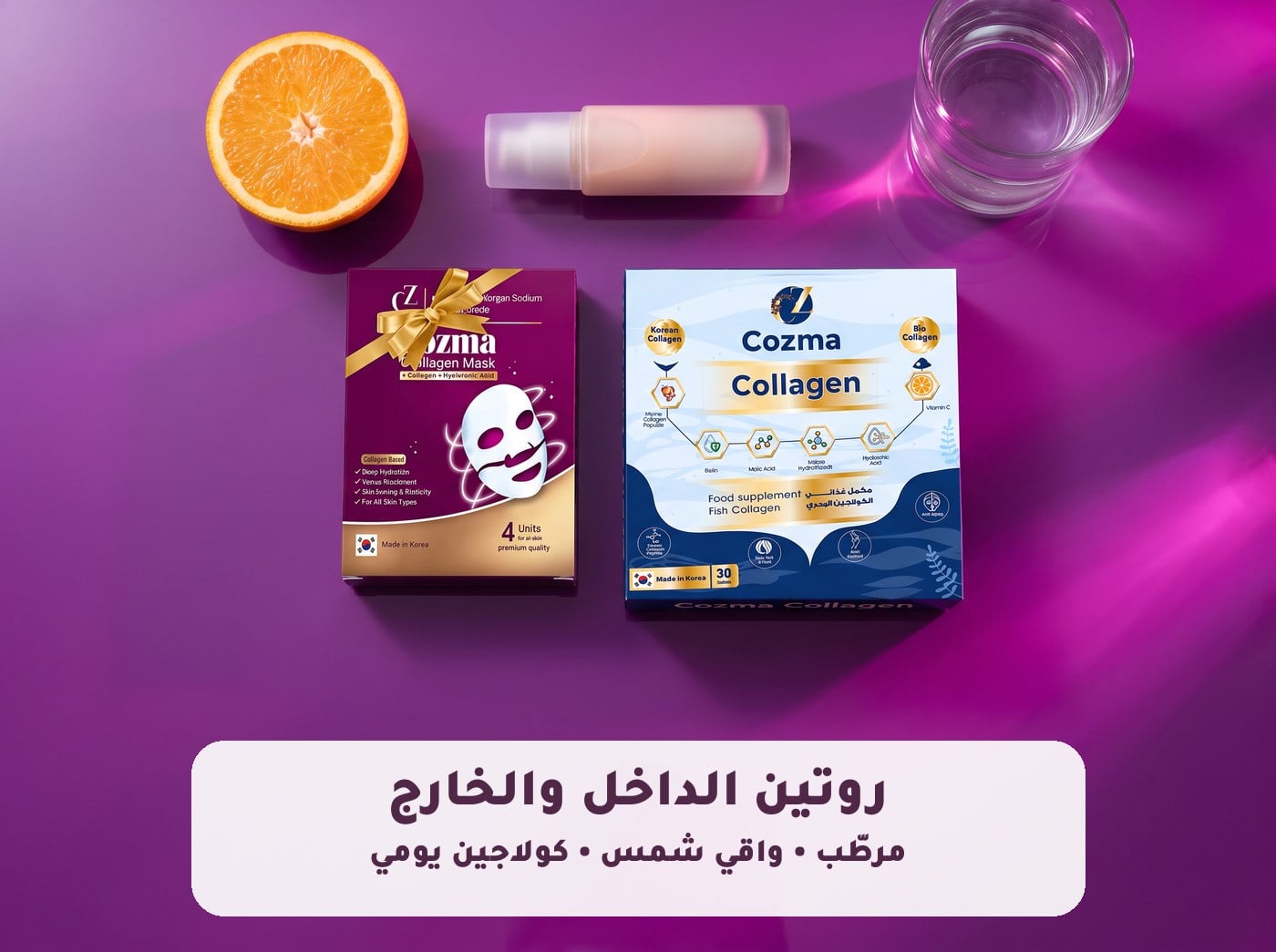
- Morning: Gentle cleanser, moisturizer (collagen cream or any moisturizer that suits you), and sunscreen.
- During the day: A sachet of dissolved marine collagen in a glass of cold water, along with food containing sources of vitamin C.
- At night: a moisturizer, and if your doctor advises you, retinol at an appropriate concentration.
- Once or twice a week: a moisturizing mask for a pampering and smoothing session.
And most importantly: consistency. Studies on drinking collagen lasted weeks, not days.
Where does Kozma Collagen appear in the picture?
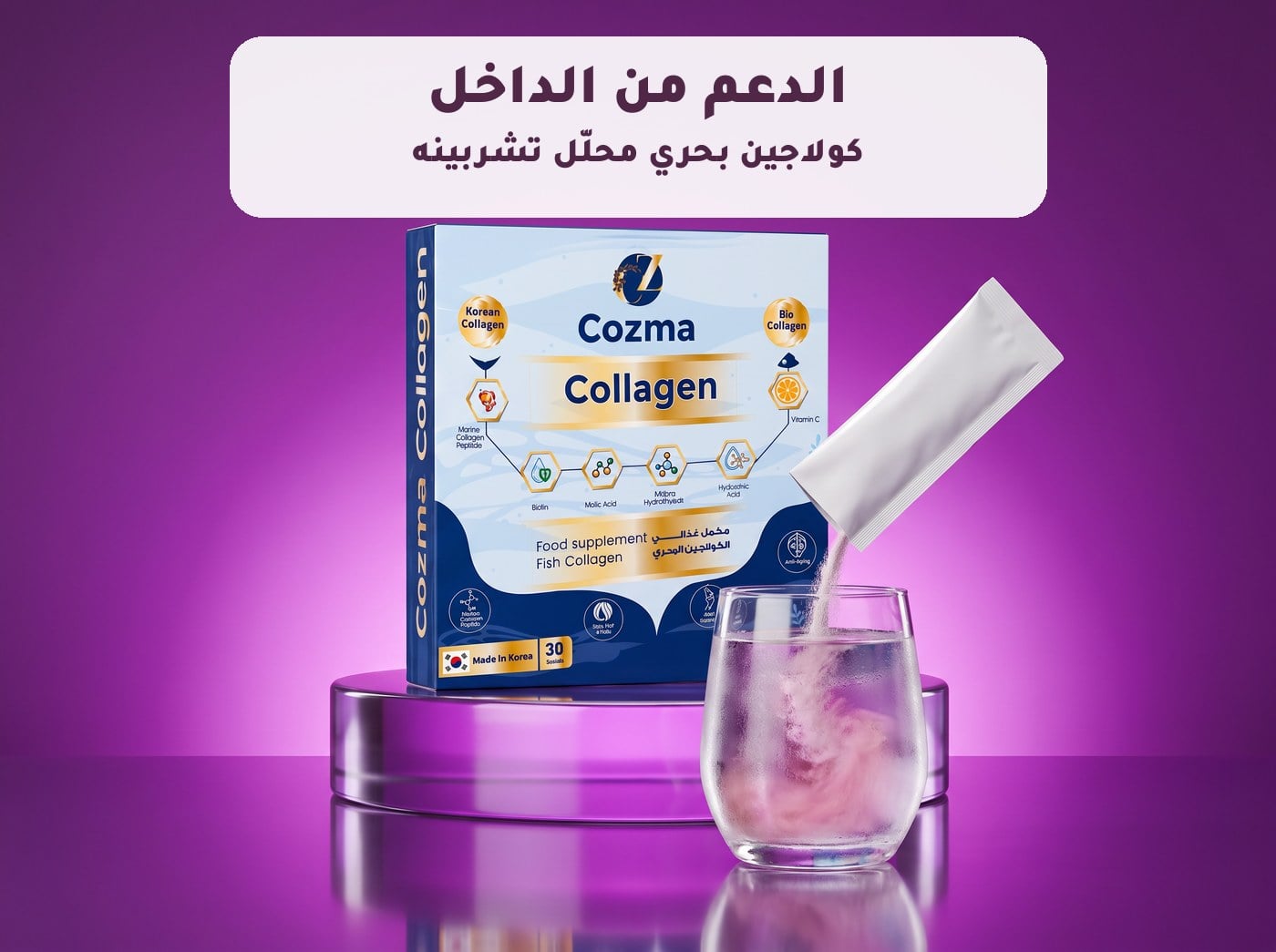
Cosma Korean hydrolyzed marine collagen, types 1 and 3. Drink one sachet daily in a glass of cold water. The same sachet contains vitamin C, which contributes to natural collagen formation. This is the "internal" part of the routine, and it comes with a free collagen mask for the "external" part. Choose what suits you best:
- Cosma Collagen 1 Month Course + Free Collagen Mask Course — 495
- 3-month Cosma Collagen course + 3 free Collagen Mask courses — 1330
Frequently asked questions about collagen cream
Does collagen cream tighten the skin?
The feeling of smoothness and plumpness after using the cream often comes from moisturizing the skin's surface, and this is a temporary sensation. The entire collagen molecule is too large to cross the skin barrier, so it doesn't replenish the collagen deep within.
Which is better: collagen cream or collagen drink?
What's the "either/or" comparison? The cream moisturizes the surface, while the hydrolyzed drinking collagen supports the skin from within, and scientific reviews have noted improved skin hydration with it. Many girls combine both.
Should I use collagen cream with retinol?
There's usually no problem, because collagen cream is a moisturizer, and moisturizers help to counteract the drying effects of retinol. However, if you have sensitive skin or a skin condition, consult a dermatologist before adding retinol.
When will I see results from drinking collagen?
Results vary from person to person, and studies have followed participants for weeks. We explained the timing in detail in the article "When Do Collagen Results Appear?"
Ready to show support from within? Start with a one-month Cosma Collagen course with a free collagen mask for 495 SAR, one sachet daily with a light berry flavor.
This product is a dietary supplement and not a medicine. Consult your doctor if you are pregnant, breastfeeding, or taking medication.
Sources
- Bos JD, Meinardi MM. The 500 Dalton rule for the skin penetration of chemical compounds and drugs. Exp Dermatol. 2000. PubMed 10839713
- Aguirre-Cruz G, et al. Collagen Hydrolysates for Skin Protection: Oral Administration and Topical Formulation. Antioxidants. 2020. PMC7070905
- Effects of Oral Collagen for Skin Anti-Aging: A Systematic Review and Meta-Analysis. Nutrients. 2023. PMC10180699
- Kafi R, et al. Improvement of naturally aged skin with vitamin A (retinol). Arch Dermatol. 2007.PubMed 17515510
- Pullar JM, et al. The Roles of Vitamin C in Skin Health. Nutrients. 2017. PMC5579659
- Hughes MC, et al. Sunscreen and prevention of skin aging: a randomized trial. Ann Intern Med. 2013.PubMed 23732711