

What is collagen? Collagen is the most abundant protein in the human and mammalian body, making up about 30% of its total protein mass. It is the "scaffolding" that gives your skin, bones, tendons, and cartilage their strength and structure. Scientists know of 28 types of collagen, but only three are the most common: types I, II, and III ( Ricard-Blum, 2011 ).
In this guide, we explain simply what collagen is, where each type is found in your body, why it decreases with age, where to get it from, and how to choose the right collagen supplement for you, away from exaggerated promises.
What is collagen and what is its function in the body?
Imagine your skin as a mattress: the outer layer is the fabric, while the inner layer (the dermis) is the springs that hold its shape. Collagen is a key component of these "springs"; strong protein fibers made up of three strands twisted together like a braided rope.
Collagen's primary function is structural: it gives tissues strength and firmness. Therefore, you will find it in:
- The skin: where the first and third types of fibers are gathered in the dermis.
- Bones and tendons: The first type is predominant in them.
- Cartilage: The second type is predominant in this type.
( Ricard-Blum, Cold Spring Harbor Perspectives in Biology, 2011 )
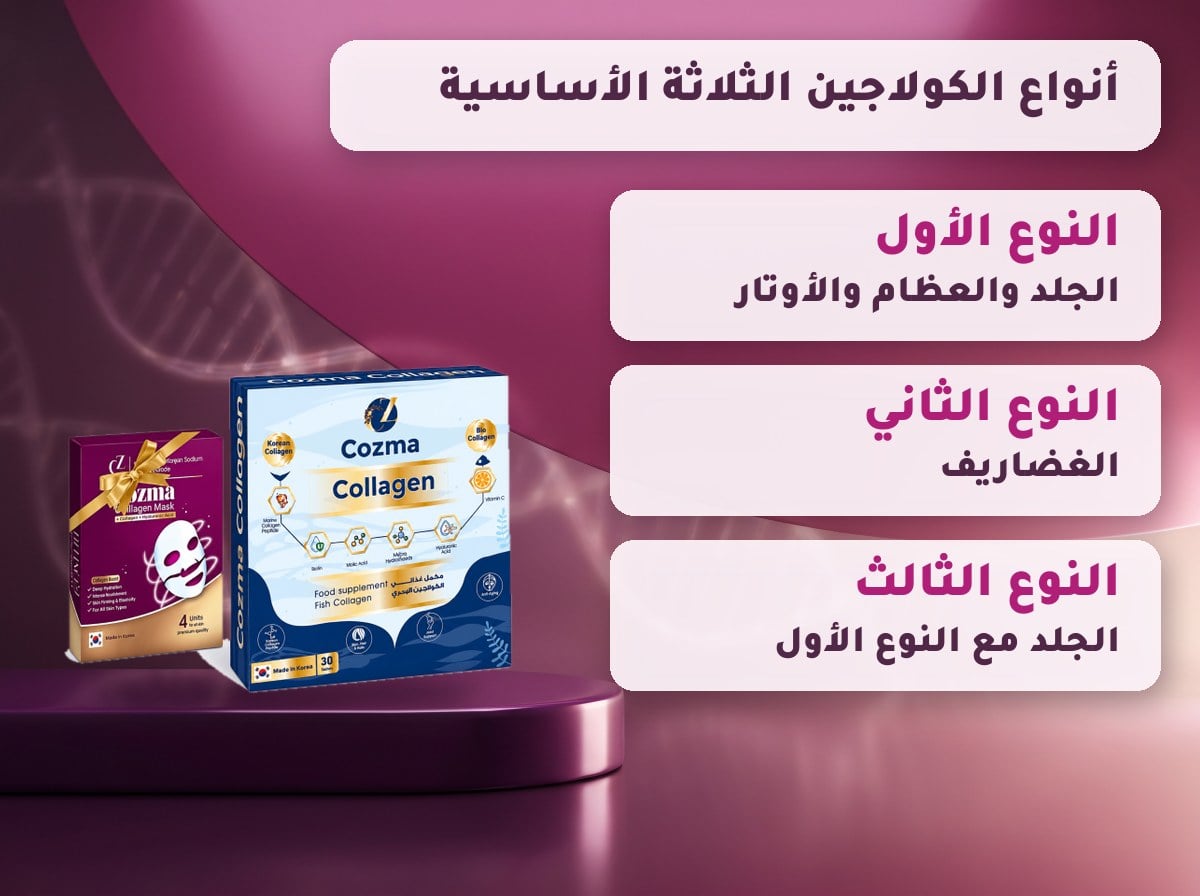
The three basic types of collagen: the difference between type I, II, and III
Of the 28 types, these are the three you'll find on supplement containers. Understanding the difference between them is the most important step before buying:
Type I: Skin and bone protein
It's the most widespread type in the body, found in skin, bones, and tendons. If your primary focus is skin, hair, and nails, this is the type you're looking for on the label.
Type II: Cartilage type
It is concentrated in cartilage, and therefore supplements containing it are often marketed to those who are concerned about daily movement and joints, and not specifically for the skin.
Type III: The skin partner of Type I
It exists alongside type 1 in the skin, which is why many skin supplements combine types 1 and 3 together.
- Type 1: It is mainly found in the skin, bones, and tendons, and is suitable for those interested in skin, hair, and nails.
- The second type: It is mainly found in cartilage, and is usually marketed to those interested in joints and movement.
- Type 3: It is found in the skin along with type 1, and is often combined with it in skin supplements.
If you are comparing a marine source with a bovine source, then read our article about the difference between marine and bovine collagen .
Why does collagen decrease with age?
Your body constantly builds and renews collagen, but this process slows down over time. In a study published in the American Journal of Pathology, researchers compared the skin of people over 80 with the skin of young people between 18 and 29 years old, and found that the fibroblasts (responsible for making collagen) in older people produced less type I procollagen, attributing this to the aging of these cells and the lack of "mechanical stimulation" they receive in aging skin ( Varani et al., 2006 ).
Besides age, the sun plays a significant role: chronic UV exposure is associated with a marked loss of collagen fibers in the dermis ( Pullar et al., Nutrients 2017 ). Therefore, daily sunscreen application remains one of your most important habits for maintaining your skin's collagen, especially in the Kingdom's sun.
Sources of collagen: From food to supplements
Collagen in food
Collagen is an animal protein because it's a component of skin, bones, and connective tissue. Therefore, it's found in foods like fish skin, chicken, and other foods rich in connective tissue. Plant-based foods don't contain collagen, but they do provide the building blocks your body needs to produce it.
Vitamin C: The indispensable helper
Vitamin C acts as a cofactor for enzymes that stabilize the triple structure of the collagen molecule, meaning your body needs it during collagen production ( Pullar et al., 2017 ). You can find it in oranges, bell peppers, strawberries, and guava. We've compiled a complete list for you in our article , "Collagen Boosters: Foods and Habits That Help Your Body ."

Hydrolyzed collagen supplements
Most collagen supplements today are "hydrolyzed," meaning that the large collagen fibers are broken down into smaller peptides. In a systematic review and meta-analysis of 26 randomized controlled trials and 1721 participants, hydrolyzed collagen intake was associated with improved skin hydration and elasticity compared to a placebo, with the researchers cautioning that results vary depending on the collagen source and duration of use, and that larger trials are needed to confirm these findings ( Pu et al., Nutrients 2023 ).
Why do we focus on hydrolyzed collagen? Because this aggregate analysis was specifically for hydrolyzed collagen, meaning that the previous results pertain to this formula. Therefore, when you compare two products, the word "hydrolyzed" on the label is information worth paying attention to.
In other words: hydrolyzed collagen supports skin hydration and elasticity according to available studies, but it is not a magic wand, and consistency is key.
Daily habits that help you maintain your skin's collagen
The supplement is just one step away, and your skin's collagen is also affected by your daily habits. These are the top three habits backed by science:
- Use sunscreen every day: because chronic UV exposure is associated with major changes in dermal fibers, including collagen loss ( Pullar et al., 2017 ). Apply it even on cloudy days and while driving, and reapply if you'll be out for an extended period.
- A colorful plate containing vitamin C: oranges, red and yellow bell peppers, strawberries, kiwis. Vitamin C is a cofactor in collagen production, and your body doesn't produce it on its own, so it must come from food or supplements ( same source ).
- Sufficient protein in your meals: Collagen is ultimately a protein, and your body builds it from amino acids obtained from food, such as fish, eggs, chicken, and legumes.
If you decide to add a supplement, choose a consistent time to take it every day. Whether it's morning or evening isn't as important as consistency, and we've explained this in detail in our article "The Best Time to Drink Collagen ," and how to dissolve and drink it correctly in our "Collagen Drinking Guide ."
How do you choose the right type of collagen for you?
Before you buy any box, first ask yourself: What is my goal? Then read the label like this:
- Define your goal: For skin, hair, and nails, look for type 1 (and often type 3). For cartilage, type 2 is usually marketed.
- Make sure you check the word "hydrolyzed": it is the formula that has been studied in most clinical trials on the skin.
- Look at the source: marine or beef, and choose what suits your diet and preferences.
- Look for vitamin C: its presence in the formula itself saves you an additional supplement.
- Choose a form you can stick to: sachets, powder, or tablets. Results in studies have been linked to consistent use over several weeks. Also, read these 7 things to read on the box before you buy .
Where does Cosma Collagen fit into all of this?
Cosma Collagen is a Korean hydrolyzed marine collagen of types I and III . Each sachet (7g) contains vitamin C, hyaluronic acid, and biotin. It should be taken once daily, dissolved in a glass of cold water. If your goal is healthy skin, hair, and nails, this formula is designed to support that goal from within.
You can start with a one-month Cosma Collagen course + a free Collagen Mask course (495 SAR) , or you can choose a longer commitment with a three-month Cosma Collagen course + three free Collagen Mask courses (1330 SAR) .
Frequently Asked Questions about Collagen
What is collagen in one word?
It is the most abundant structural protein in the body, giving skin, bones, tendons and cartilage their firmness and strength.
What is the best type of collagen for the skin?
There is no absolute "best" option, but type 1 is the most common in the skin, and type 3 is also present, so skin supplements usually combine them. The important thing is that it's hydrolyzed and that you use it consistently.
Can collagen be obtained solely from food?
Collagen is found in animal foods such as fish and chicken skin, and your body also makes it if you get enough protein and vitamin C. Supplements are an additional option for those who want a regular and easy source.
When do the results of collagen supplements appear?
Clinical trials have typically evaluated hydrolyzed collagen over weeks of daily use, and results vary from person to person. We discussed this in detail in our article , "When Do I See Results from Collagen?"
Start your routine from within
Now you know what collagen is, its three types, and how to choose the one that suits your goals. If your goal is smoother, more hydrated skin and stronger hair and nails, try Cosma Hydrolyzed Marine Collagen (Types 1 and 3) with Vitamin C in the same sachet, plus a free collagen mask.
Order the Cosma Collagen 3-month course now (SAR 1330) ←
This product is a dietary supplement and not a medicine. Consult your doctor if you are pregnant, breastfeeding, or taking medication.
Sources
- Ricard-Blum S. The Collagen Family. Cold Spring Harb Perspect Biol. 2011;3(1):a004978. PMC3003457
- Varani J, et al. Decreased collagen production in chronologically aged skin. Am J Pathol. 2006;168(6):1861–1868. PMID 16723701
- Pullar JM, Carr AC, Vissers MCM. The Roles of Vitamin C in Skin Health. Nutrients. 2017;9(8):866. PMC5579659
- Pu SY, et al. Effects of Oral Collagen for Skin Anti-Aging: A Systematic Review and Meta-Analysis. Nutrients. 2023;15(9):2080. PMID 37432180