
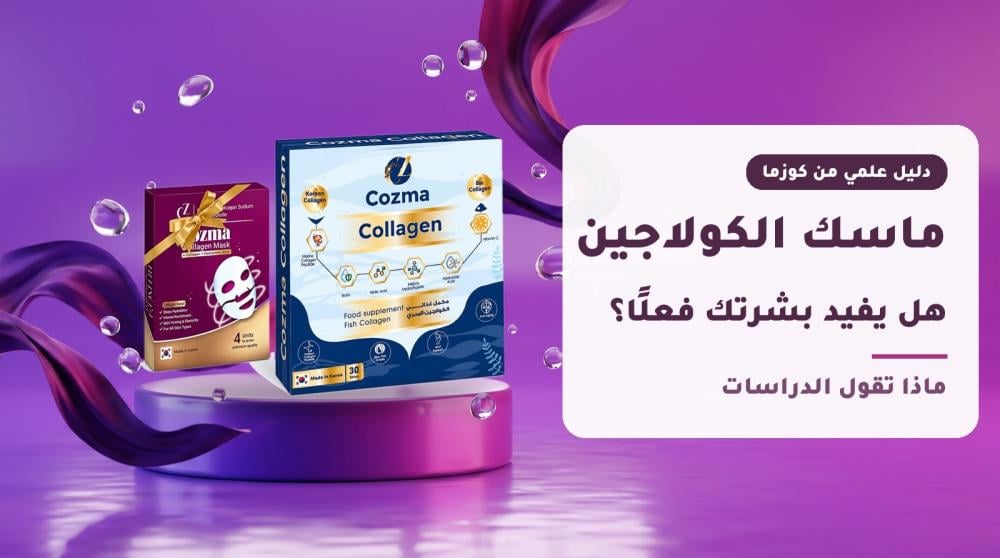
A collagen mask provides your skin with noticeable hydration and smoothness immediately after use, but it doesn't "plant" new collagen in your skin; the collagen molecule is too large to penetrate the outer layer of the skin. Its true benefit comes from two things: the hydration provided by the mask itself, and the accompanying ingredients such as niacinamide, ceramides, and panthenol. Supporting collagen production from within is best done through oral supplements. In this guide, we explain in detail what a collagen mask actually does, what studies say about its ingredients, and how to use it correctly.
What is a collagen mask?
A collagen mask is typically a sheet mask, either fabric or paper, saturated with a serum containing collagen (or hydrolyzed collagen) along with moisturizing and soothing ingredients. You apply it to a clean face for approximately 15 to 20 minutes, allowing the serum to remain in contact with the skin throughout this time.
You can find collagen masks in several forms: sheet masks, which are the most popular; hydrogel masks that adhere to the face with a gel-like consistency; and cream or gel masks that are applied with a brush and then rinsed off. The concept is the same in all types: a concentrated layer of moisturizing ingredients that stays on the skin for a few minutes. The difference lies in the texture, the application method, and what suits your routine and schedule.
This is why collagen masks have become so popular with the Korean skincare trend: an easy step, tangible results in texture and radiance, and a weekly relaxing experience that most girls love.
Does the skin absorb collagen from the mask?
Here is the point that many advertisements ignore. The outer layer of the skin (the stratum corneum) is a strong barrier, and one of the well-known rules in dermatology is the so-called “500 Dalton rule” : compounds with a molecular weight of approximately 500 Daltons are difficult to penetrate intact skin in significant quantities ( Bos & Meinardi, 2000 ).
The complete collagen molecule is a massive protein that far exceeds this limit. Therefore, the collagen in the mask remains on the skin's surface , where it works with the other serum ingredients to moisturize and smooth the skin's texture after application. This is a nice and desirable effect, but it's superficial hydration; it doesn't build new collagen within the skin.
If you want to understand the topic of molecular size more, read our article: 300 Daltons in Collagen: What Does the Molecular Size of Collagen Cosma Mean?
The real benefits of collagen masks: What do studies say about their ingredients?
The true value of any collagen mask depends on its overall formula, not just the word "collagen" in the name. These are the key ingredients you'll find in good masks, including the Kozma mask:
1. Niacinamide (Vitamin B3)
Niacinamide is one of the most studied skincare ingredients. In a study of 50 women who used a moisturizer containing 5% niacinamide for 12 weeks, improvements were observed in the appearance of fine lines, spots, redness, and dullness compared to the side where the moisturizer was not applied ( Bissett et al., 2005 ). Scientific reviews also indicate that niacinamide helps support the skin barrier by increasing the production of its natural lipids, including ceramides ( Gehring, 2004 ).
Important note: These results came from regular daily use for weeks. The weekly mask adds support to your routine and is not a replacement for it.
2. Ceramides
Ceramides are among the most important lipids that make up the outer layer of the skin. They play a vital role in the skin's barrier function, preventing water loss and protecting it from irritants. A deficiency in ceramides is linked to dry skin and other skin problems ( Choi & Maibach, 2005 ). Therefore, the presence of ceramides in face masks contributes to skin hydration and comfort, especially given the Kingdom's dry climate and constant use of air conditioning.
3. Panthenol (provitamin B5)
Panthenol is a well-known moisturizing and soothing ingredient, and a scientific review shows that it acts as a humectant that improves stratum corneum hydration, reduces transdermal water loss, and helps maintain skin smoothness and elasticity ( Ebner et al., 2002 ).
4. Instant hydration from the mask itself
Besides the ingredients, the sheet mask itself is a convenient way to apply a generous layer of serum to the face all at once, which is why girls love it before events and outings to get a smoother texture and a fresher look.
Collagen mask or collagen supplement? The difference between external and internal
The mask and the supplement do not compete; rather, each works in a different way:
- Collagen mask (from the outside): Moisturizing, smoothness and radiance on the surface of the skin, which you will notice after use.
- Collagen supplement (from within): Hydrolyzed collagen peptides taken orally. A systematic review and meta-analysis of 19 randomized trials and 1125 participants found that 90 days of hydrolyzed collagen supplementation was associated with improvements in skin hydration, elasticity, and wrinkle appearance compared to placebo ( de Miranda et al., 2021 ).
This means: If your goal is quick smoothing before an event, a face mask is an excellent option. If your goal is long-term skin support, an oral supplement is essential, and ideally, combining the two is best. For more on when results appear, read: When do collagen results appear?
How to use a collagen mask step by step
- Cleanse your face with a gentle cleanser and pat dry.
- Open the mask and spread it on your face starting from the forehead, aligning the openings for the eyes, nose, and mouth.
- Leave it on for 15 to 20 minutes or as per the package instructions, and do not leave it on until it is completely dry on the face.
- Gently peel it off and massage the remaining serum onto your face and neck until it is absorbed, without washing your face.
- Finish with a moisturizer to lock in hydration; once a week is enough as part of your routine.
Common mistakes that negate the benefits of a face mask
- Exceeding the stated time: Prolonging the mask application does not mean greater benefit, so adhere to the time stated on the packaging and remove it before it dries.
- Applying it to an unclean face: Makeup residue and sunscreen reduce the serum's contact with the skin, so always start with a clean face.
- Wash your face immediately afterward: the remaining serum is part of the benefit, so massage it in instead of washing it off.
- Forgetting moisturizer: Moisturizing after a mask helps to keep moisture in place for a longer time.
- Expect a lasting result from one use: the mask provides temporary radiance and smoothness, and continuing with a complete routine is what makes the difference over time.
Who is a collagen mask suitable for?
Collagen masks are suitable for most skin types, especially:
- Dry or tight skin due to air conditioning and hot, dry weather.
- Dull skin that needs a boost of radiance before an event, party, or photoshoot.
- For those who like a simple and quick skincare routine, which can be used while they are relaxing or watching their show.
If your skin is very sensitive or you have a skin condition being treated by a doctor, consult your dermatologist before adding any new product to your routine.
Tips before you choose a collagen mask
- Read the ingredient list and look for studied ingredients such as niacinamide, ceramides and panthenol, not just the word “collagen”.
- Try the mask on a small part of your skin first if you have sensitive skin.
- Avoid applying the mask to irritated or wounded skin.
- Be wary of any product that promises "clinic-level" results or exaggerated figures without research.
Kozma Collagen Mask: A gift with the Marine Collagen Course
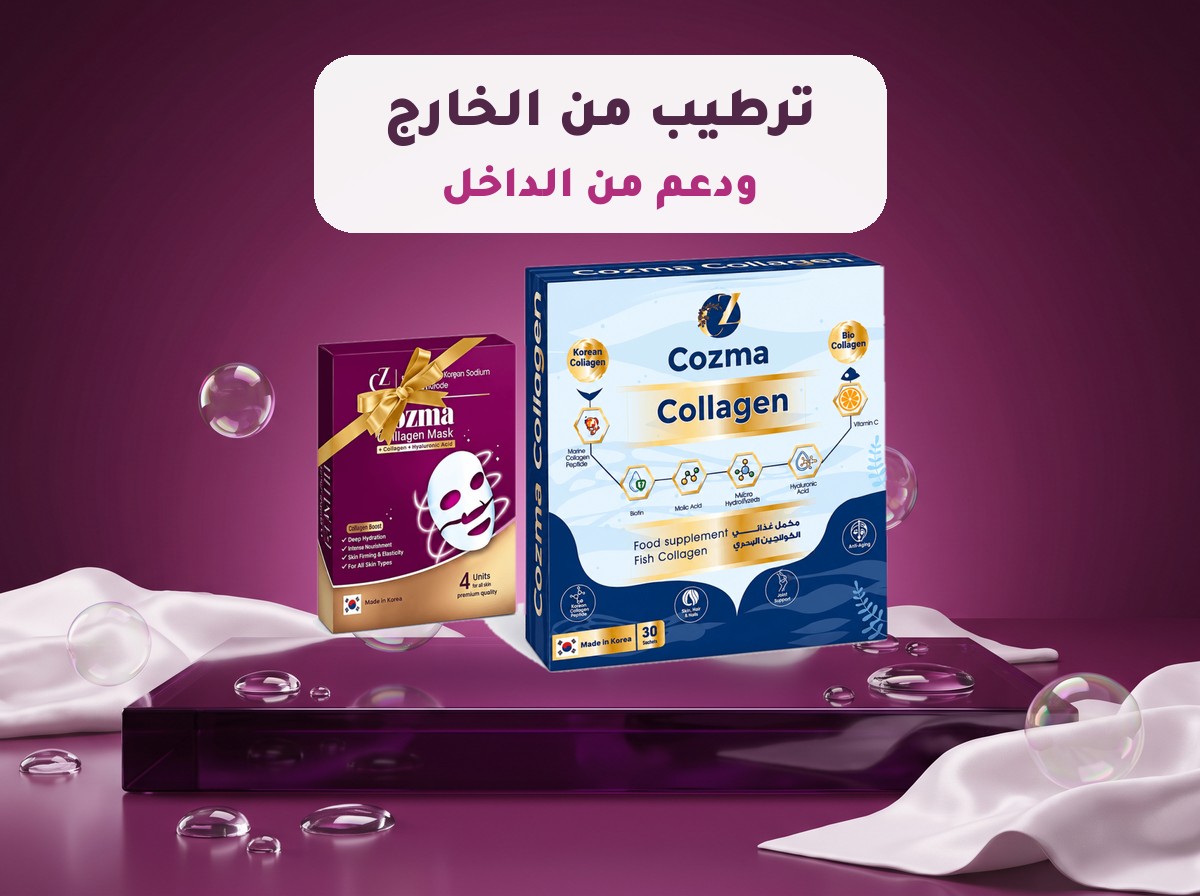
At Kozma, we've designed a two-pronged routine: a sachet of Kozma Korean marine collagen in a glass of cold water every morning to nourish your skin from within, and a Kozma collagen mask once a week for external application. The mask contains collagen, niacinamide, ceramides, panthenol, and snail extract, and each box contains four masks.
The mask comes as a gift with Cosma Collagen courses:
- Kozma Collagen One Month Course + Collagen Mask Course Gift for 495 Riyals (30 Sachets + Mask Box).
Kozma Collagen 3-month course + 3 free Collagen Mask courses for 1330 Riyals (90 sachets + 3 mask boxes).  ]
Frequently asked questions about collagen masks
Does a collagen mask tighten the skin?
It gives the skin a smoother texture and a more youthful appearance thanks to hydration, but it doesn't build new collagen within the skin because the collagen molecule is too large to penetrate the skin. This is where oral collagen supplements come in to support your skin from within.
How often should I use a collagen mask?
In the Kozma routine, we recommend one mask per week, while adhering to the package instructions and the duration of use.
Should I wash my face after using a collagen mask?
This is usually not necessary; simply massage the remaining serum into the skin until absorbed, then apply your moisturizer. If it feels irritatingly sticky, you can gently wipe off the excess.
Does a collagen mask replace a collagen supplement?
No, each has its role: the mask moisturizes the skin from the outside, and the supplement supports it from within. Studies on long-term improvements in skin elasticity and hydration have been conducted on hydrolyzed collagen taken orally.
Start your routine from the inside out.
If a simple and clear routine is found, a sachet of collagen every morning and a mask once a week, then start with a one-month Cosma Collagen course with a free collagen mask for 495 riyals, and divide it into 4 interest-free installments with Tamara or Tabi.
This product is a dietary supplement and not a medicine. Consult your doctor if you are pregnant, breastfeeding, or taking medication.
Sources
- Bos JD, Meinardi MM. The 500 Dalton rule for the skin penetration of chemical compounds and drugs. Exp Dermatol. 2000.PubMed
- Bissett DL, et al. Niacinamide: AB vitamin that improves aging facial skin appearance. Dermatol Surg. 2005.PubMed
- Gehring W. Nicotinic acid/niacinamide and the skin. J Cosmet Dermatol. 2004.PubMed
- Choi MJ, Maibach HI. Role of ceramides in barrier function of healthy and diseased skin. Am J Clin Dermatol. 2005.PubMed
- Ebner F, et al. Topical use of dexpanthenol in skin disorders. Am J Clin Dermatol. 2002.PubMed
- de Miranda RB, et al. Effects of hydrolyzed collagen supplementation on skin aging: a systematic review and meta-analysis. Int J Dermatol. 2021.PubMed